English
You've got a concert coming up, a corporate event, or maybe a touring production — and you need a stage LED video wall that won't embarrass you in front of thousands of people. So you start searching for china stage led video wall manufacturers, and within five minutes you're drowning in a sea of Alibaba listings, GoldSupplier pages, and company websites that all look suspiciously similar. Every single one of them claims to be the "leading manufacturer" with "competitive pricing" and "premium quality." But here's the thing — I've been sourcing stage LED displays from China for over a decade now, and I can tell you that the gap between the best manufacturers and the worst ones is enormous. The difference isn't just in price. It's in whether your screen survives the third day of a five-day festival without half the modules going dark.
Let me walk you through everything I've learned about finding the right china stage led video wall manufacturers for your project — from understanding what actually matters in a stage display, to pricing realities, to the mistakes that cost people real money.
This is where a lot of buyers go wrong right out of the gate. A stage LED video wall is not just a big TV screen. It's a piece of production equipment that needs to perform under conditions that would kill a standard display in hours.
Here's what separates stage-specific LED panels from generic ones:
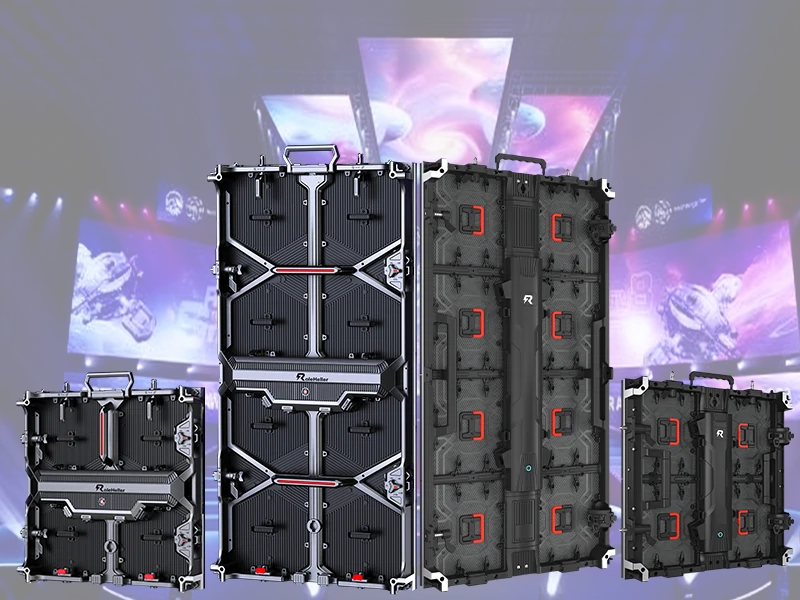
Rapid assembly and disassembly — stage setups happen in hours, not days. Panels need quick-lock mechanisms that let a crew of four assemble a 50-sqm wall in under an hour. I'm talking about tool-free connections with alignment precision within 0.1mm.
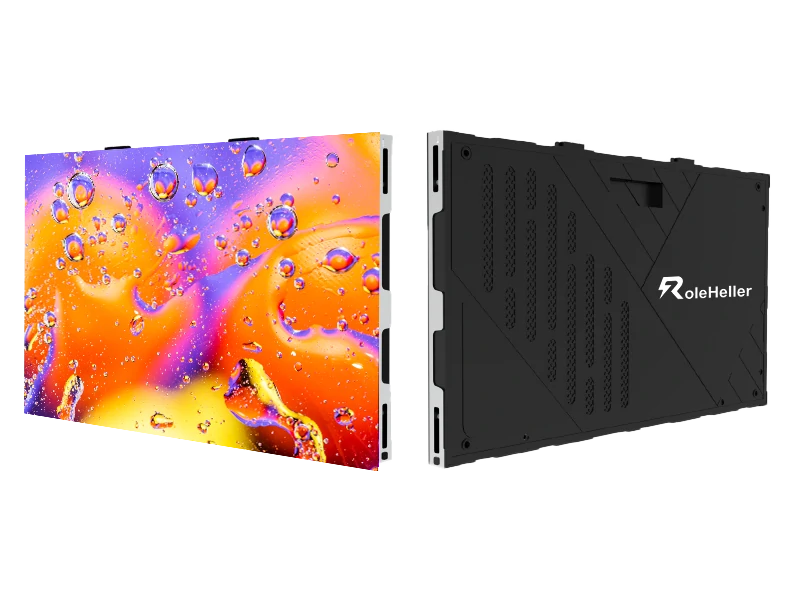
Lightweight die-cast aluminum cabinets — a standard 500×500mm rental cabinet should weigh between 6.5 and 8.5 kg. Anything heavier and your rigging costs skyrocket. I've seen crews struggle with 12 kg cabinets that were marketed as "lightweight" — turns out the manufacturer was comparing them to steel, not aluminum.
High refresh rates — minimum 3,840Hz for any stage application where cameras will be present. Below that, you get visible scan lines on camera feeds, and your broadcast partner will not be happy.
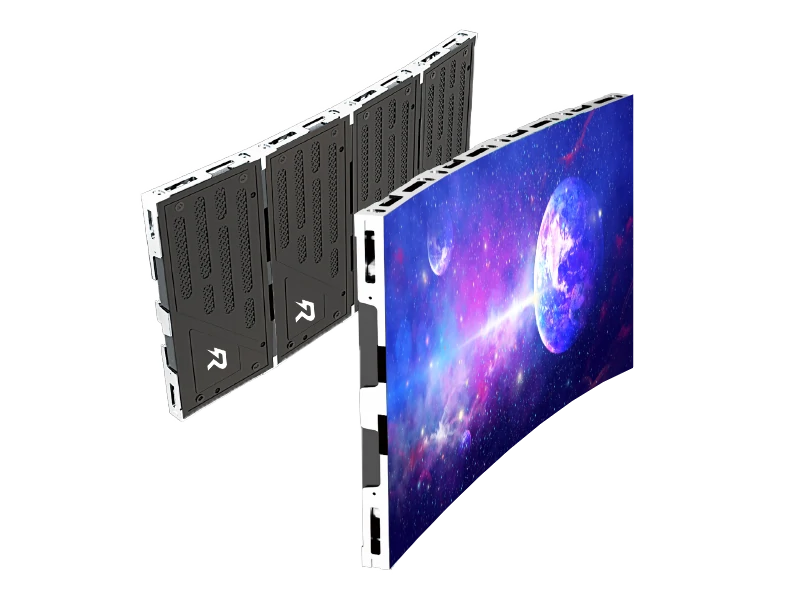
Curvature capability — stage designs increasingly use curved and arc-shaped configurations. Panels need to support both convex and concave curves, typically between -5° and +10° per cabinet connection.
Front and rear maintenance access — when a module dies mid-show (and it will, eventually), your technician needs to swap it from the front without dismantling the entire wall.
China's LED display industry is overwhelmingly concentrated in Shenzhen, with secondary clusters in Xiamen and Beijing. The companies producing stage-specific LED video wall panels fall into clear tiers, and understanding this hierarchy will save you a lot of time.
These are the companies you've probably heard of: Leyard, Unilumin, Absen, LianTronics, and ROE Visual (which is Swedish-headquartered but manufactures in China). These companies generate hundreds of millions in annual revenue, have dedicated stage/rental product lines, and supply major global events — the Olympics, FIFA World Cup, Grammy Awards, Super Bowl halftime shows.
According to industry data, Leyard controls roughly 18% of the global rental LED display market, while Unilumin holds about 15%. Together with Absen and LianTronics, these four Chinese manufacturers account for well over 50% of the world's stage LED panels.
The trade-off with Tier 1 is pricing. You're paying for brand recognition, extensive R&D, global service networks, and the overhead that comes with being a publicly accountable company. For stage rental panels, you're typically looking at $1,800–$3,500 per sqm depending on pixel pitch and specifications.
This is where I've found the sweet spot for most projects. Companies with 500–3,000 employees, dedicated stage/rental product lines, and the certifications you need for international work. Names like Gloshine, INFiLED, Retop, Lampvision, and YUCHIP fall into this category.
Gloshine, for instance, holds roughly 85% market share in concert displays for Hong Kong and Taiwanese stars performing in mainland China, and their products have appeared at the FIFA World Cup, the Olympics, and the CCTV Spring Festival Gala. INFiLED has carved out a strong reputation in the international rental market specifically.
Pricing from Tier 2 manufacturers typically runs $900–$1,800 per sqm for standard stage rental panels. The key is verifying that their stage-specific products are a core part of their business, not just a line item in a broad catalog.
Under 500 employees, often competing primarily on price. Some produce perfectly acceptable panels for budget-conscious projects. Others cut corners on aging tests, use lower-grade LED chips, and their "quick-lock" mechanisms are anything but quick after the third setup.
| Tier | Annual Revenue | Employees | Price per sqm (USD) | Best For |
|---|---|---|---|---|
| Tier 1 (Leyard, Unilumin, Absen) | $300M+ | 5,000+ | $1,800–$3,500 | Major tours, broadcast events, flagship venues |
| Tier 2 (Gloshine, INFiLED, YUCHIP) | $50M–$300M | 500–3,000 | $900–$1,800 | Regional tours, corporate events, mid-scale productions |
| Tier 3 (Small Shenzhen factories) | Under $50M | Under 500 | $500–$1,000 | Budget events, indoor fixed installations, domestic market |
Here's something I wish someone had explained to me clearly before my first big stage order: pixel pitch selection for stage displays is driven almost entirely by your minimum viewing distance and whether cameras will be capturing the screen.
The industry rule of thumb is straightforward — optimal viewing distance in meters roughly equals the pixel pitch in millimeters. A P3.91 screen looks sharp from about 4 meters away. A P2.6 screen works well from 2.5+ meters. But stage applications add a camera constraint that doesn't apply to fixed installations.
| Pixel Pitch | Min Viewing Distance | Camera-Safe? | Price per sqm (USD) | Typical Use |
|---|---|---|---|---|
| P2.6 | 2.5m+ | Yes, excellent for close camera work | $1,500–$2,800 | TV studios, close-up stage, corporate events |
| P2.97 | 3m+ | Yes, good for most camera work | $1,200–$2,200 | Concerts with camera crews, theater |
| P3.91 | 4m+ | Acceptable for medium-distance cameras | $800–$1,500 | Large concerts, festivals, outdoor stages |
| P4.81 | 5m+ | Marginal for cameras, great for audience-only | $650–$1,200 | Outdoor festivals, large venues, budget productions |
If your stage will be filmed or broadcast, I'd strongly recommend P2.97 or finer. I learned this the hard way when a P4.81 wall looked great to the naked eye but produced visible moiré patterns on the live stream. The client was not impressed.
Let's get into the numbers because this is where expectations collide with reality the hardest. Stage LED video wall pricing from Chinese manufacturers varies based on pixel pitch, cabinet material, LED chip brand, and order volume.
For a standard indoor stage rental panel (500×500mm die-cast aluminum cabinet):
P2.6 indoor — $1,500–$2,800 per sqm from mid-tier manufacturers
P2.97 indoor — $1,200–$2,200 per sqm
P3.91 indoor — $800–$1,500 per sqm
P3.91 outdoor — $900–$1,800 per sqm (IP65 rated, higher brightness)
P4.81 outdoor — $650–$1,200 per sqm
These figures represent the panel hardware only. You still need to budget for:
Control systems (NovaStar, Colorlight, or Brompton processors) — $2,000–$15,000 depending on scale
Video processors and scaling — $1,500–$8,000
Flight cases and transportation hardware — $50–$100 per panel
Spare modules — budget 8–10% of your total panel count
What pushes the price up:
Premium LED chips (Cree, Nichia) vs. domestic brands like Nationstar — adds 15–25%
Higher refresh rates (3,840Hz vs. 1,920Hz) — adds 10–15%
Carbon fiber or magnesium alloy cabinets — lighter than aluminum but significantly more expensive
GOB (Glue on Board) protection — adds impact resistance for rental use, costs 10–20% more
What brings costs down:
Standard cabinet sizes (500×500mm is the industry workhorse)
Larger order quantities — per-sqm pricing drops noticeably past 30 sqm
Accepting standard configurations — the manufacturer's bread-and-butter models are always cheapest
If someone quotes you $300/sqm for a P3.91 stage rental panel, something is deeply wrong. At that price, they're using the cheapest available LEDs, skipping aging tests entirely, and the quick-lock mechanisms are probably going to strip after a few setups.
This is the section that will save you from the kind of mistakes that cost tens of thousands of dollars. The gap between what a company's website says and what their factory floor actually looks like can be enormous.
Don't accept a polished promotional video. Request a live video call and ask to see specific things:
The aging room with panels actively burning in — a real stage panel manufacturer will have hundreds of rental cabinets running 48–72 hour burn-in tests. This is non-negotiable for rental panels that need to survive continuous multi-day events.
The quick-lock mechanism testing area — ask them to demonstrate the lock engagement. A quality quick-lock should engage with a single lever action and hold cabinets together with zero visible gap.
The incoming LED chip inspection station — where LED modules are checked for brightness and wavelength consistency before assembly.
A genuine manufacturer welcomes this kind of scrutiny. If they stall or make excuses, that tells you everything.
Some manufacturers are strong in fixed installations but have minimal experience with rental/stage products. The two require very different engineering approaches. A company that primarily makes fixed outdoor billboards might not understand the mechanical stresses that rental panels endure — being loaded and unloaded from trucks hundreds of times, assembled and disassembled weekly, and subjected to the vibration of bass speakers.
Ask for specific project references in the stage/rental space. A manufacturer that has supplied panels for major concert tours, TV broadcasts, or festival productions will have documented proof.
When you're importing stage LED video wall panels for international events, certifications determine whether your shipment clears customs and whether your insurance covers the display.
| Certification | Market | What It Covers |
|---|---|---|
| CE (EN 62368-1 + EN 55032) | EU/EEA/UK | Safety + EMC for audiovisual equipment |
| ETL / UL Listed | USA & Canada | Electrical safety for commercial equipment |
| FCC Part 15 Class B | USA | Electromagnetic emissions for indoor equipment |
| IP65 Test Report | Global | Dust and water ingress protection (outdoor panels) |
| ISO 9001 | Global | Quality management system certification |
Here's a critical distinction: "CE marked" is not the same as "CE tested by a third party." Some manufacturers self-declare CE conformity without any independent verification. Always ask for the actual test report from a recognized laboratory — TÜV, SGS, Intertek — and verify the report number directly with the issuing body.
Let me share some hard-won lessons.
On a 50-sqm stage wall, you should order 8–10% spare modules from the same production batch. LED chips shift in color over time. A replacement module from a new batch six months later will look visibly different under stage lighting. I learned this when a client needed 15 modules replaced after a transport accident, and the new batch didn't match the surrounding panels at all under the stage lights.
A 500×500mm cabinet at 8 kg sounds light. But when you're hanging 200 of them from a truss structure, that's 1,600 kg plus cabling, power distribution, and safety factors. Your rigging engineer needs accurate weight specifications — not the bare cabinet weight, but the fully assembled weight including power supplies, receiving cards, and cabling.
Before your panels ship, insist on a factory acceptance test where a representative section is assembled, run for 72+ hours, and checked for dead pixels, color uniformity, and cabinet fitment. Catching a defective module at the factory takes 10 minutes. Catching it during load-in at the venue, with a crew of 20 standing around at $50/hour each, is a very different conversation.
A stage LED wall is only as good as the content it displays. Content designed for a 16:9 TV screen looks terrible on a 32:9 ultra-wide stage backdrop. Budget separately for content designed at the native resolution and aspect ratio of your specific wall configuration.
This depends entirely on your usage frequency. If you're doing 15+ events per year, purchasing starts to make financial sense — a quality set of P3.91 rental panels pays for itself in about 8–12 rental bookings. Below that threshold, renting from a local provider is usually more economical when you factor in storage, maintenance, transportation, and depreciation.
For orders above 20 sqm, going direct to the manufacturer almost always makes sense. You get better pricing, direct technical support, and a clear warranty chain. Distributors add 15–25% margin but provide local stock and faster delivery. If your timeline is tight or you need local technical support during events, a distributor with genuine stage display expertise can be worth the premium.
Three approaches, and I'd recommend combining them:
Hire a third-party inspection company (SGS, Bureau Veritas, QIMA) for pre-shipment inspection — typically $300–$500 per day
Request a live video factory acceptance test where you watch the wall being assembled and tested in real time
Order a sample cabinet first before committing to a full order — ship it to your venue and test it under actual stage conditions
After years of working with stage LED manufacturers across China, here's where I've landed: the right manufacturer depends on your specific situation. There's no single "best" option — only the best option for your particular project, budget, and risk tolerance.
For major tours and broadcast events where failure is not an option, the Tier 1 companies deliver peace of mind through extensive testing, comprehensive certifications, and global service networks. For the majority of corporate events, regional tours, and mid-scale productions, established Tier 2 manufacturers offer the best balance of quality, capability, and value. They have the production infrastructure to deliver consistent stage panels, the certifications your project needs, and the flexibility to accommodate custom requirements.
What matters most is that you verify claims independently, understand the total cost of ownership rather than just the purchase price, and build a relationship with a manufacturer who treats your project as important. The companies worth partnering with are the ones who ask you detailed questions about your application, push back when a spec request would compromise reliability, and provide documentation rather than marketing promises.
Q1: Who are the top China stage LED video wall manufacturers?
The leading manufacturers include Leyard, Unilumin, Absen, and LianTronics among publicly listed companies, along with Gloshine, INFiLED, ROE Visual, and YUCHIP among established mid-size producers. Leyard holds roughly 18% of the global rental LED market, while Unilumin commands about 15%. These companies supply major global events including the Olympics, FIFA World Cup, and international concert tours. For budget-conscious projects, Shenzhen's ecosystem of smaller factories offers competitive pricing, though due diligence on quality is essential.
Q2: What pixel pitch is best for stage LED video walls?
For indoor stages with camera capture, P2.6 to P2.97 delivers the best balance of image quality and cost. P3.91 is the industry workhorse for large concerts and festivals where the audience is 4+ meters from the screen. P4.81 works well for outdoor stages and budget productions where camera capture is not a primary concern. The key principle: match pixel pitch to your minimum viewing distance, and go one step finer if cameras will be capturing the display.
Q3: How much does a stage LED video wall from China cost?
Prices range from $650 to $3,500 per square meter depending on pixel pitch, manufacturer tier, and specifications. A standard P3.91 indoor rental panel from a mid-tier manufacturer costs $800–$1,500 per sqm. Finer pitches like P2.6 push pricing to $1,500–$2,800 per sqm. These figures cover panel hardware only — control systems, video processors, flight cases, and spare modules are additional costs that typically add 15–25% to the total project budget.
Q4: What certifications do I need when importing stage LED panels from China?
For the EU/UK market, CE marking under EN 62368-1 (safety) and EN 55032 (EMC) is mandatory. For the US market, ETL/UL listing and FCC Part 15 Class B compliance are typically required. For outdoor stage panels, IP65 test reports from accredited laboratories are essential. Always verify certifications with actual test reports from recognized labs like TÜV, SGS, or Intertek rather than relying on self-declared markings.
Q5: How long does it take to manufacture and deliver stage LED panels from China?
Standard rental panel models in stock ship within 10–15 business days. Custom configurations require 20–30 business days for production. Add 20–35 days for sea freight depending on your destination, or 5–7 days for air freight at 4–6x the cost. For urgent event timelines, some manufacturers maintain stock of popular models that can ship within 5 business days.
Q6: What control systems work with Chinese stage LED video walls?
NovaStar is the most widely supported control system, with processors like the VX600 and VX1000 offering robust performance for stage applications. Most Chinese LED manufacturers optimize their receiving cards for NovaStar compatibility. Colorlight A-series processors are a strong alternative for larger installations. Brompton Tessera processors serve the premium segment where broadcast-quality color accuracy is essential, particularly for XR virtual production stages.
Q7: Should I buy or rent stage LED panels?
If you're producing 15+ events per year, purchasing starts to make financial sense — a quality set of P3.91 rental panels typically pays for itself in 8–12 rental bookings. Below that threshold, renting from a local provider is usually more economical when you factor in storage, maintenance, transportation, and depreciation costs. Consider hybrid approaches too — own your most-used configuration and rent specialty sizes as needed.
Q8: How do I ensure quality when ordering stage LED panels from overseas?
Combine multiple quality assurance approaches: hire a third-party inspection company (SGS, Bureau Veritas) for pre-shipment inspection, request a live video factory acceptance test before shipping, order a sample cabinet to test under your actual stage conditions, and specify 8–10% spare modules from the same production batch. A detailed quality agreement covering dead pixel thresholds, color uniformity specs, and brightness consistency should be part of your purchase contract.
Q9: What is the expected lifespan of stage rental LED panels?
Quality stage rental panels from established manufacturers typically last 50,000–100,000 hours of LED operation. However, for rental panels, mechanical lifespan is often the limiting factor — quick-lock mechanisms, connector pins, and cabinet edges endure significant wear from repeated assembly and disassembly. Well-maintained panels from Tier 1 and Tier 2 manufacturers typically deliver 5–8 years of active rental service before cosmetic and mechanical wear becomes significant.
Q10: Can Chinese manufacturers provide custom-shaped stage LED panels?
Yes, established manufacturers routinely produce custom cabinet dimensions, curved panels, and non-standard configurations for stage applications. Custom shapes typically add 10–20 business days to production time and may carry a 15–25% price premium. Common custom requests include curved arc sections, triangular corner pieces, and ultra-wide panoramic configurations. Provide exact dimensions, viewing distance, and content requirements early in the process for the best results.
.jpg "Where to Find Reliable China P2.6 Outdoor LED Video Wall Manufacturers?")